



Most data visualizations are meant to answer a specific question — show me where and where people shop, show me how rainfall changed over decades, show me the gap between our targets and our results, show me…
But once in a while, the data juggler goes beyond the utilitarian purpose and adds another dimension to the presentation by spinning actual data into a form of art. The data is real, the conveyed meaning is there, but instead of burying it on 95th page of some PDF report you want it hanging on your wall.
Lithuania’s national statistics agency makes some of the best examples I’ve seen, and they do it semi-officially.

The piece
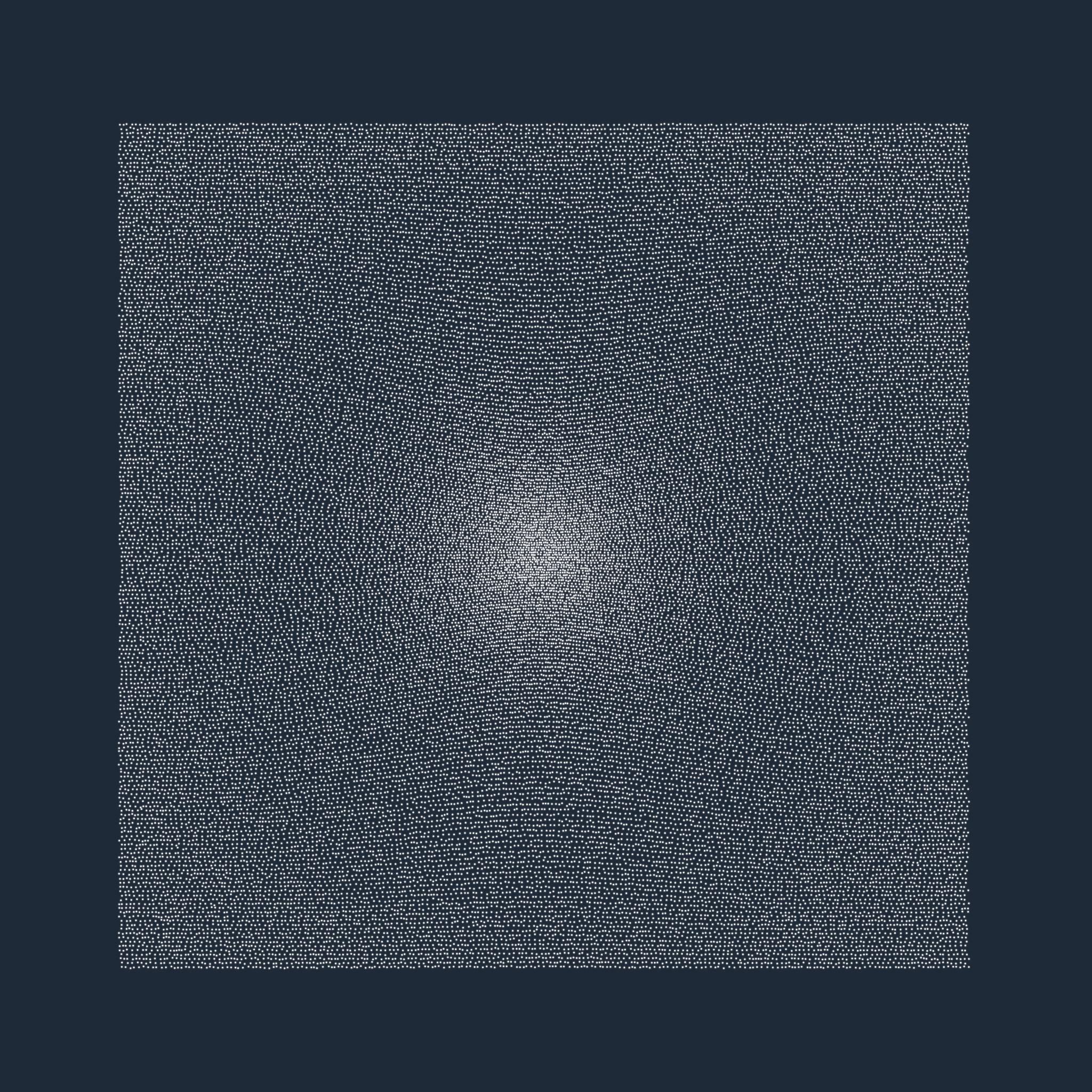
Eight sine waves stacked vertically. One per note from the opening of the Lithuanian national anthem. Higher pitch means more oscillations across the same width — that’s the whole encoding rule. There are no axis labels, no legend, no key. You just look at it.
It works because the rule is simple and the data behind it is clear. The repeating notes draw the same wave, so the visual rhythm of the print is the actual rhythm of the music. It happens to also be a beautiful print.
The agency publishes it with a description that, in translation, reads roughly:
This work is suitable for philosophical contemplation of State, sovereignty, symbolism, music, and information modalities. It can be hung on the wall, as an alternative to portraits of J. Basanavičius, Žemaitė, or the President.
This is a national statistics agency suggesting their data art as an alternative to portraits of a country’s founding father, its most beloved 19th-century writer, and a sitting head of state. I cannot stress enough how delightful this is.
It’s a whole programme, not a one-off
The anthem isn’t a single accident. It belongs to a twelve-work cycle the agency produced in 2022–2023, one piece per Lithuanian government ministry. Lietuvos himnas is the Ministry of Culture’s. The other eleven each take some quantity that ministry actually deals with — budgets, casework, geographies, demographics — and turn it into a piece designed to be looked at, not parsed. Across the set, the visual language stays minimalist: lines, points, geometry, the occasional curve.

The agency draws the distinction between this work and their regular infographics explicitly. The everyday infographics are dominated by numbers, tables, and color-coding; they exist to compress facts into a glance. The art-leaning pieces, which they call infografika, are described in their own publications as “fusing data with the aesthetics of graphic art — line, point, minimalism,” intended for “abstract aesthetic or meaningful philosophical enjoyment.” A national statistics office writing the words “philosophical enjoyment” in a publication is its own kind of cultural achievement.
The city circles
Another series from the same agency features visually striking set of round map fragments — each one cut out at a fixed radius from a Lithuanian city center and flattened into a minimal palette of beige, terracotta, dark teal, and mustard. Buildings, water, parks, roads, all rendered as flat blocks of color. They look like coins, or souvenir tin lids, or the round patches you’d embroider onto a backpack. They happen to be drawn from real cadastral and land-use data, not an artist’s Photoshop.


The trick the series pulls is that, even without the corner tag telling you which city you're looking at, anyone who's been there can probably guess. The river bend, the rail spurs, the lakes — the data does the identification for you. Which is the whole point of cartography, restated as design.
It’s part of a small but distinguished tradition
Data rendered as art has a small canon, and the Lithuanian project sits comfortably in it. A short tour of the company it keeps:
Dear Data (Giorgia Lupi & Stefanie Posavec, 2014–15). For 52 weeks, two information designers on opposite sides of the Atlantic mailed each other hand-drawn postcards. Each postcard recorded one week’s worth of personal data — how often they laughed, complained, were indecisive, noticed something about strangers — encoded in a different visual language each time. The data is genuine; the legend that decodes it is on the back of the card. The Museum of Modern Art acquired the original 104 postcards and the accompanying sketchbooks for its permanent collection.

Flight Patterns (Aaron Koblin, 2005). FAA flight-tracking data for 24 hours over North America, plotted as glowing arc trajectories on a black field. You can see the continent fall asleep and wake up, the East Coast hubs flare, the long-haul lines to Europe trace the great-circle route. Also in MoMA’s collection.

Nathalie Miebach's woven weather (2006–present). Boston-based artist Nathalie Miebach translates meteorological data — Hurricane Sandy, Hurricane Maria, blizzards — into basket-woven sculptures. Each bead, dowel, and reed encodes a specific measurement. The output hangs from gallery ceilings; the input is loggable in a spreadsheet.

Unsupervised (Refik Anadol, 2022). 138,151 images from MoMA's collection, fed into a generative model and projected as a continuously morphing "machine hallucination" across a giant media wall in the museum's lobby. The data is the museum's actual catalog. The output is its own thing entirely. Three million people came to see it, including yours truly.

The cool trend
What unites all those fascinating works is simple: the underlying data is honest, the encoding rules are real (a real frequency, a real flight path, a real wind speed, a real cataloged painting), and yet the rendering’s goal is something other than “answer this question quickly.” The piece is meant to be looked at, not parsed. There’s often no axis. There’s often no legend. The viewer figures out what they’re looking at, and the figuring-out is part of the experience.
What makes the Lithuanian work particularly charming, and worth singling out, is its source. Most of the works come from independent artists and studios with one foot in the design world. The VDA’s pieces come from a national statistics office — the same institution that publishes Lithuania’s GDP figures, employment numbers, and crop yields — quietly suggesting that the public frame one of their prints and put it on the wall.
DataViz Dojo was created by amCharts team. We’re not here to peddle you our data-viz lib. We’re here to have fun with facts, data, cartography, and history, blending it all into beautiful visual stories. Subscribe, follow, or simply check in regularly for more compelling stuff!